
Montgomery County Court Records After a Jail Arrest
After a Montgomery County arrest and booking at the county jail, the court record begins when a criminal case is opened through the prosecutor and court system. In Indiana, the local prosecutor represents the State in felony and misdemeanor prosecutions from crimes committed in Montgomery County. The court and Clerk maintain the case file after filing; the jail does not become the custodian of the court case just because the person was booked there.
The custody side belongs with the Sheriff's Office and the Montgomery County Jail. Use jail inmate records for current custody and booking-route questions, and use jail mugshots for booking-photo availability. Court records after an arrest are searched through Indiana MyCase and, when documents are not online, through the Montgomery County Clerk.
How to Find Montgomery County Court Records After an Arrest
Start with MyCase for the public case index. MyCase can be searched by case, party, or attorney, and a recent Montgomery County jail arrest may later appear under the defendant's name or a cause number from court paperwork, bond paperwork, jail information, or an attorney. MyCase is not a live jail roster, so it should not be treated as proof that someone is still in custody at 600 Memorial Drive.
The official Indiana MyCase search page is the statewide court-case entry point for Montgomery County criminal cases.
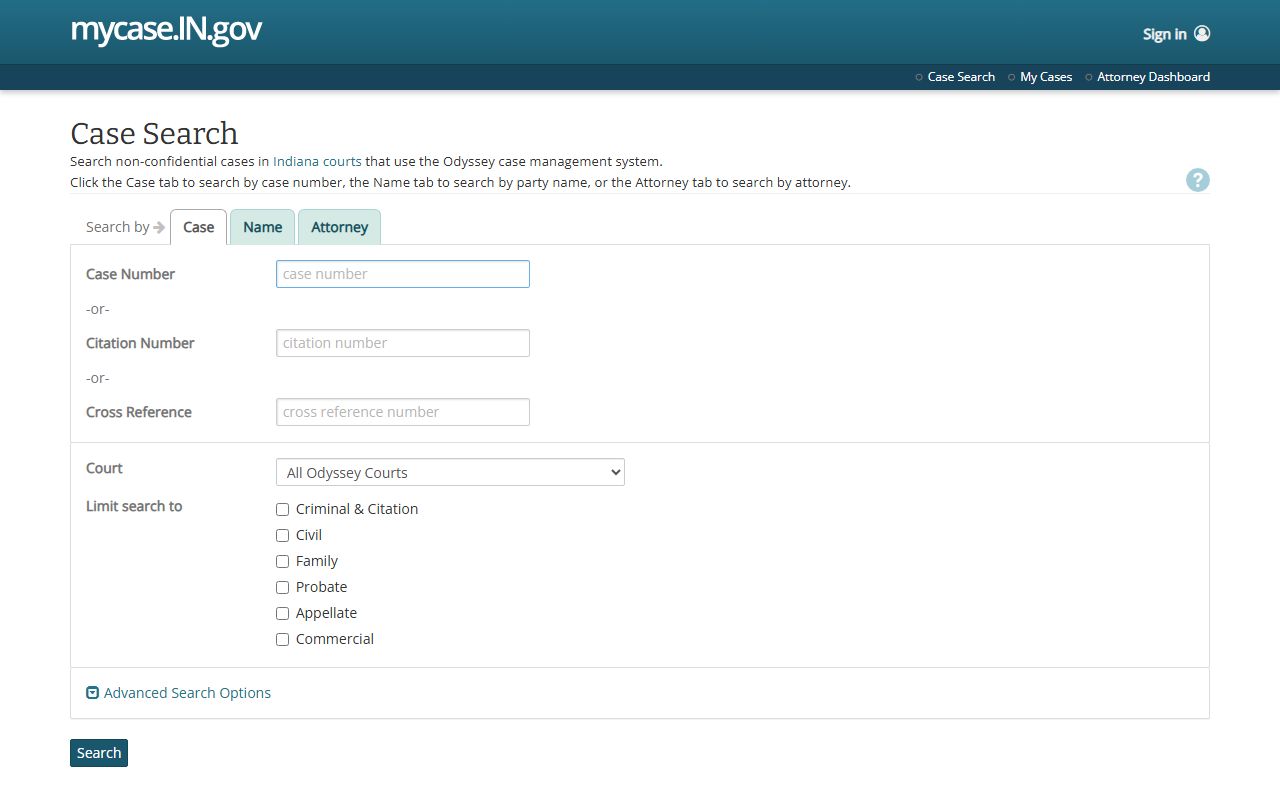
Use the search mode that matches what is known: party name when only the defendant's name is known, case number when a cause number is available, or attorney search for legal research.
- Open MyCase and choose the case or party search mode.
- Search by defendant last name, first name, or cause number; add date of birth only when needed and known.
- Limit results to Montgomery County courts when the filter is available.
- Open the case and review the charge list, case status, hearings, disposition, and sentencing entries that are public.
If the person is not found, search with name variations, prior surnames, middle names, or a shorter first-name entry. MyCase search tips note that wildcards must be at the end of a value and that party searches using first name, middle name, or date of birth require a last name. For immediate custody status, use the sheriff's Find an Inmate page or call the jail at (765) 362-3740.
How Charges Get Filed After an Arrest: Complaint, Information, and Indictment
Booking charges at the jail can be preliminary. The court charge record becomes clearer after the prosecutor files a charging document or otherwise pursues the case. Montgomery County uses the Indiana court system, and the Office of the Montgomery County Prosecuting Attorney handles felony and misdemeanor prosecutions for crimes committed in the county. The prosecutor is important to the charge path, but the Clerk and MyCase are the court-record channels.
| Complaint | Information | Indictment | |
|---|---|---|---|
| Filed By | Law-enforcement officer or prosecutor, depending on case posture | Prosecutor | Grand jury process |
| Common For | Initial criminal allegations and many misdemeanor filings | Many Indiana felony prosecutions | Less common, usually serious matters |
| Starts | A public case if accepted and filed by the court | The formal criminal case | The formal criminal case after indictment |
Charge Status in Court Records After an Arrest
Charges can change after filing. A jail roster may show the arresting-agency charge at intake, while MyCase may show the charge filed by the prosecutor, later amendments, hearings, and final disposition. Read each charge separately instead of assuming every arrest charge became a conviction.
| Status | What It Means |
|---|---|
| Pending | The charge or case is open and has not reached a final disposition. |
| Amended / Reduced | The original allegation changed by later filing, plea, court order, or prosecutor action. |
| Dismissed | The charge was ended and is not a conviction for that charge. |
| Nolle Prosequi | The prosecution declined to continue that charge, subject to the court record and Indiana procedure. |
Bond and Release After an Arrest
Release after a Montgomery County jail arrest depends on the court order, warrant terms, initial-hearing process, any bond amount, and any holds from another agency. The sheriff's Jail Info page links AllPaid for online inmate bond payments, but payment should be made only after the jail or court confirms the amount, eligibility, and whether a detainer or no-bond order blocks release.
| Bond Type | How It Works |
|---|---|
| Cash Bond | Money is paid through the court or jail process to secure appearance and release when allowed. |
| Surety Bond | A licensed bail agent posts bond under a separate fee or contract; official county sources did not publish a local bonding-company list. |
| PR / Own Recognizance | The court releases the person on a promise to appear and follow conditions instead of requiring full payment. |
| No-Bond Hold | Release is unavailable because of a court order, warrant, probation/parole hold, another county hold, federal hold, or immigration hold. |
Warrants That Lead to an Arrest
Montgomery County, Indiana did not have a fully documented official active-warrant search database in the inspected sources. The sheriff does publish a Most Wanted page with photographs and charges, but that page is not the same as a complete warrant list or a jail roster. The page directs people not to attempt apprehension and gives the Montgomery County Communications Center reporting number, (765) 362-3300.
For warrant questions, use the sheriff/jail number, (765) 362-3740, or the non-emergency number, (765) 362-0885. MyCase can show related court events, failure-to-appear activity, case numbers, and public orders, but it does not guarantee that a warrant is active at the moment of search.
Charges vs. Convictions
An arrest and a filed charge are accusations, not proof of guilt. A conviction appears only after a plea, verdict, or judgment. Court records after an arrest should be read with the disposition, sentencing entries, and dismissal or amendment history, especially when the jail booking entry and the filed court charge do not match.
| Charge | Conviction | |
|---|---|---|
| Stage | Accusation or filed count | Final outcome after plea, verdict, or judgment |
| Burden of Proof | Probable cause or charging standard | Beyond a reasonable doubt or guilty plea |
| Public Record | Often public unless sealed, confidential, juvenile, or expunged | Often public unless restricted by law or court rule |
Sealed vs. Expunged Arrest Records
Indiana expungement law, IC 35-38-9, can restrict public access to qualifying criminal records. MyCase access notes state that granted expungement cases have no online access, while pending or denied expungement matters may still have non-confidential orders and documents online or available in person. That means an older Montgomery County court record may be absent from MyCase because it is expunged, confidential, sealed, or outside online coverage.
| Sealed / Restricted | Expunged | |
|---|---|---|
| Visibility | Hidden from ordinary public access under court rule, statute, or order | Restricted under Indiana expungement law when granted |
| Law Enforcement | May retain access depending on the rule or order | Access may remain for certain legal and law-enforcement purposes |
| Eligibility | Depends on record type, confidentiality law, juvenile status, or court order | Depends on IC 35-38-9 and the case outcome, timing, and offense type |
Background Check Considerations
Casual public lookup and regulated background screening are different uses. Anyone using criminal court records for employment, housing, credit, insurance, licensing, or another regulated decision should use a legally compliant screening process and verify records with the originating court or agency.
Important: Montgomery County Inmate Population is not a consumer reporting agency under the FCRA and is not for FCRA-covered screening.
Restricted Court Records After an Arrest in Montgomery County
Indiana court access is not unlimited. The Indiana court document access table says many criminal case documents are not available online even when the case index is searchable. Criminal felony, misdemeanor, Level 1-6 felony, murder, and post-conviction matters may show sentencing orders online while other non-confidential documents require clerk access.
For agency records outside the court file, Indiana's Access to Public Records Act is the public-records framework, and the Indiana Public Access Counselor publishes APRA guidance. Court documents are handled under Indiana court-access rules, so an APRA request to the sheriff is not the same as a court-copy request to the Clerk.
The Indiana Judicial Branch court document access page explains why a case can appear in MyCase while specific documents remain clerk-only or restricted.
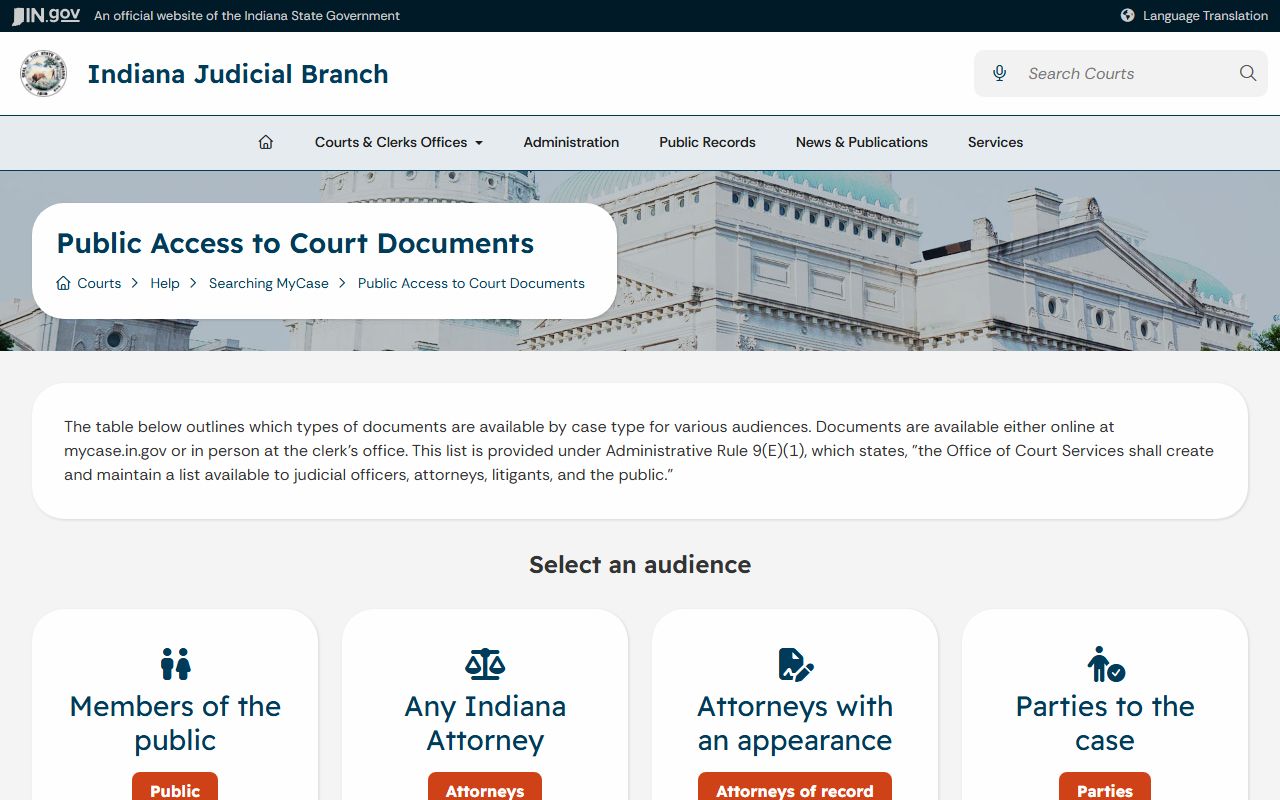
For Montgomery County copies not available online, contact the Clerk of the Circuit Court at 100 E Main St, Room 102, Crawfordsville, IN 47933, phone (765) 364-6430. For prosecution-office routing, victim resources, traffic deferral, pretrial diversion, or child-support division questions, contact the Prosecutor's Office instead of treating that office as the court-file custodian.